Your Financial Advisor Is Charging You Millions
June 2, 2026
A 1% fee sounds small. Many financial advisors charge an AUM ("assets under management") fee: a percentage of your portfolio, deducted directly from your account instead of billed as an invoice. The deductions appear on your quarterly statements. What the statements don't show is what those deductions add up to over a career, once you count the growth that money would have earned.
Consider two high earners: a tech worker and a physician, both consistent investors throughout their careers. A standard 1% AUM fee costs the tech worker $1.56 million by retirement. The physician loses $1.40 million. Nothing else in their models changes.
Millions In Fees
The charts below show the investing trajectories for the tech worker (Alex) and physician (Blake) outlined in previous posts, with one addition: a 1% AUM fee charged every year.
Both models assume a 7% annual return after inflation, and the fee lowers it to 6%. All figures are in today's dollars.
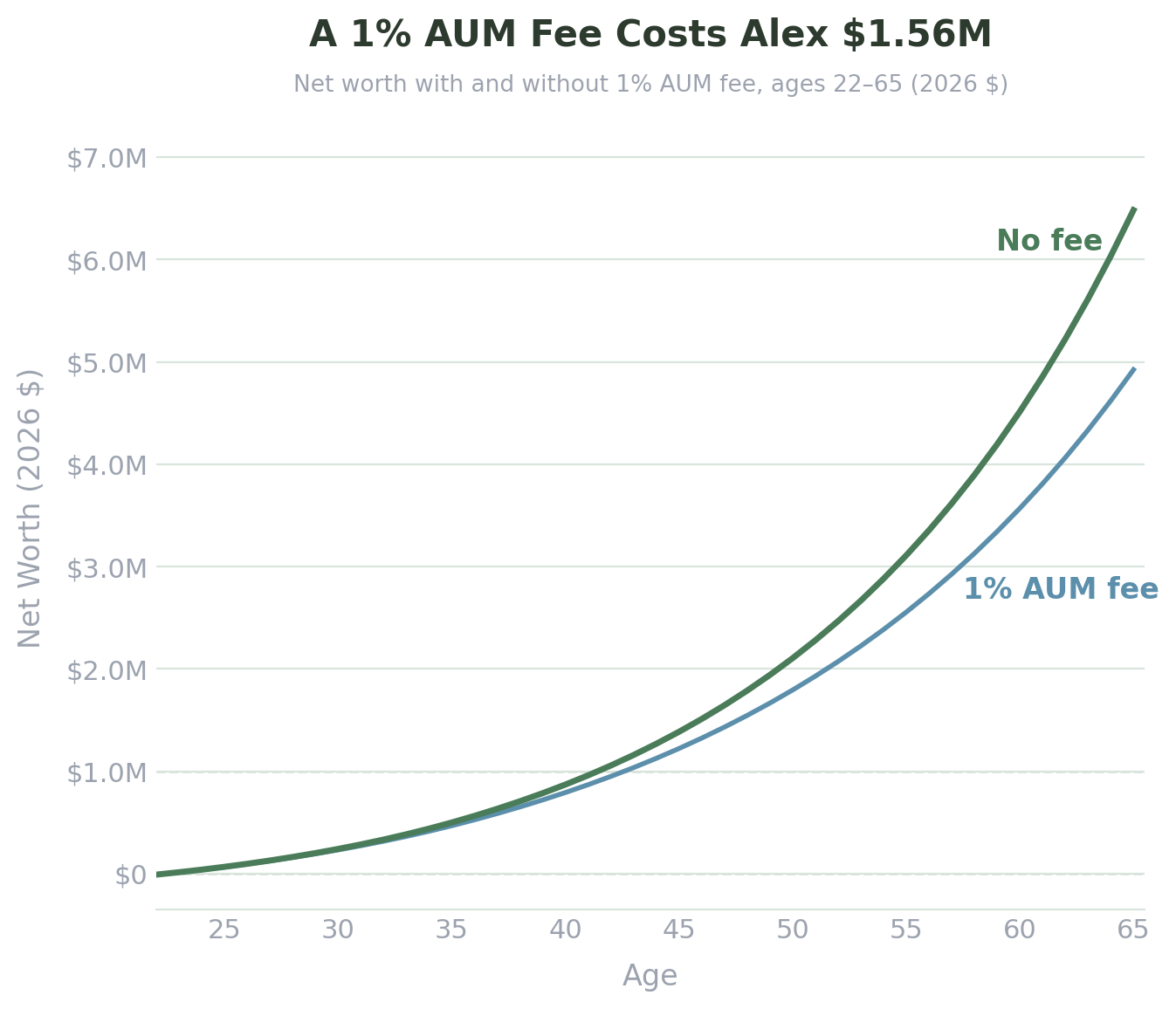
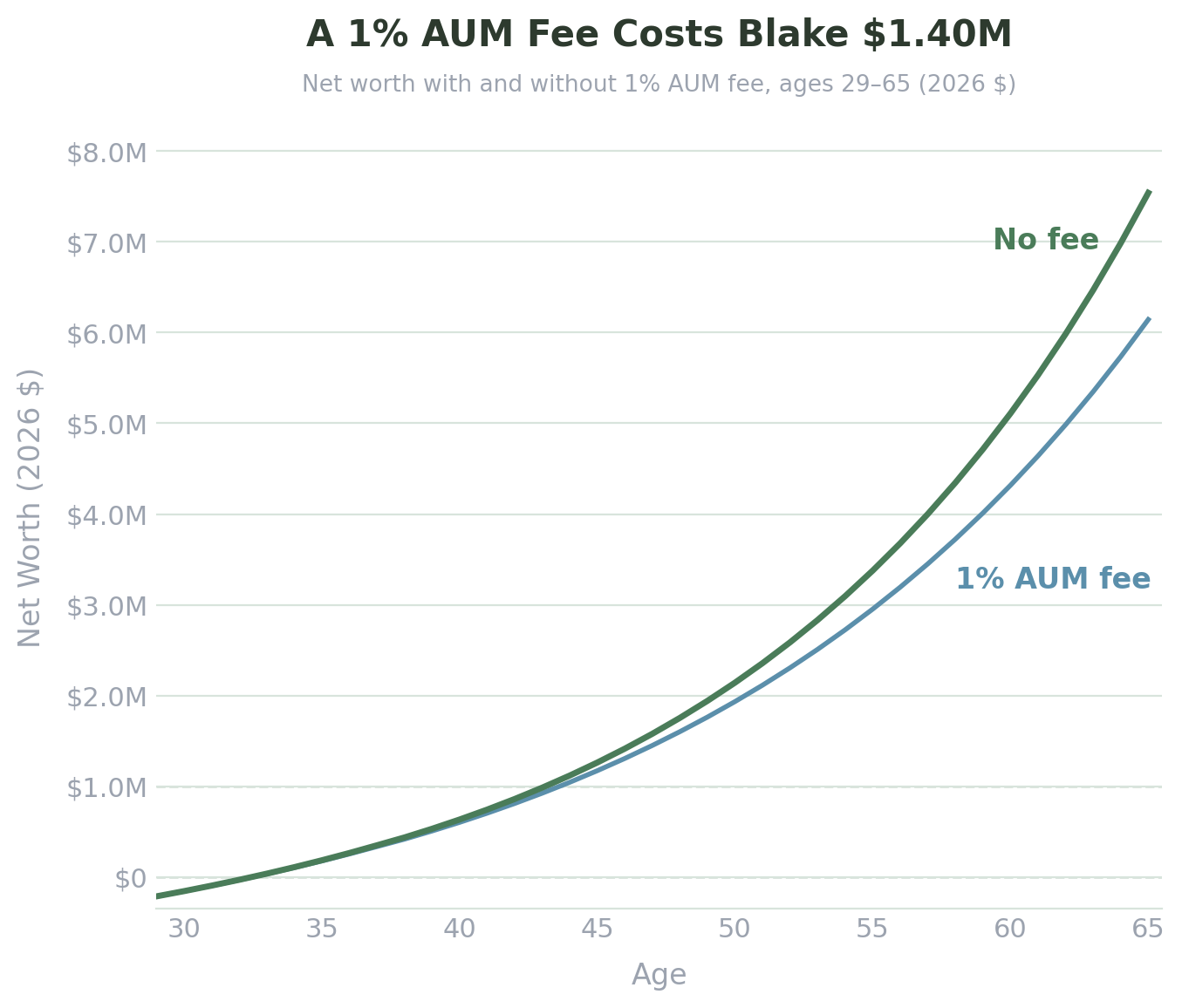
Early in both careers, the fee is nearly invisible. At 30, Alex has lost about $9,600 to fees, barely noticeable against a growing portfolio. However, the fee compounds just like the portfolio does, and by retirement the gap is well over a million dollars for both.
Alex loses about as much to fees as they earn in their first 15 years of working. Blake loses more than 5 years of their attending salary.
Compounding Works Both Ways
The charts below zoom into the final decade of both careers, where the fee damage is most visible.
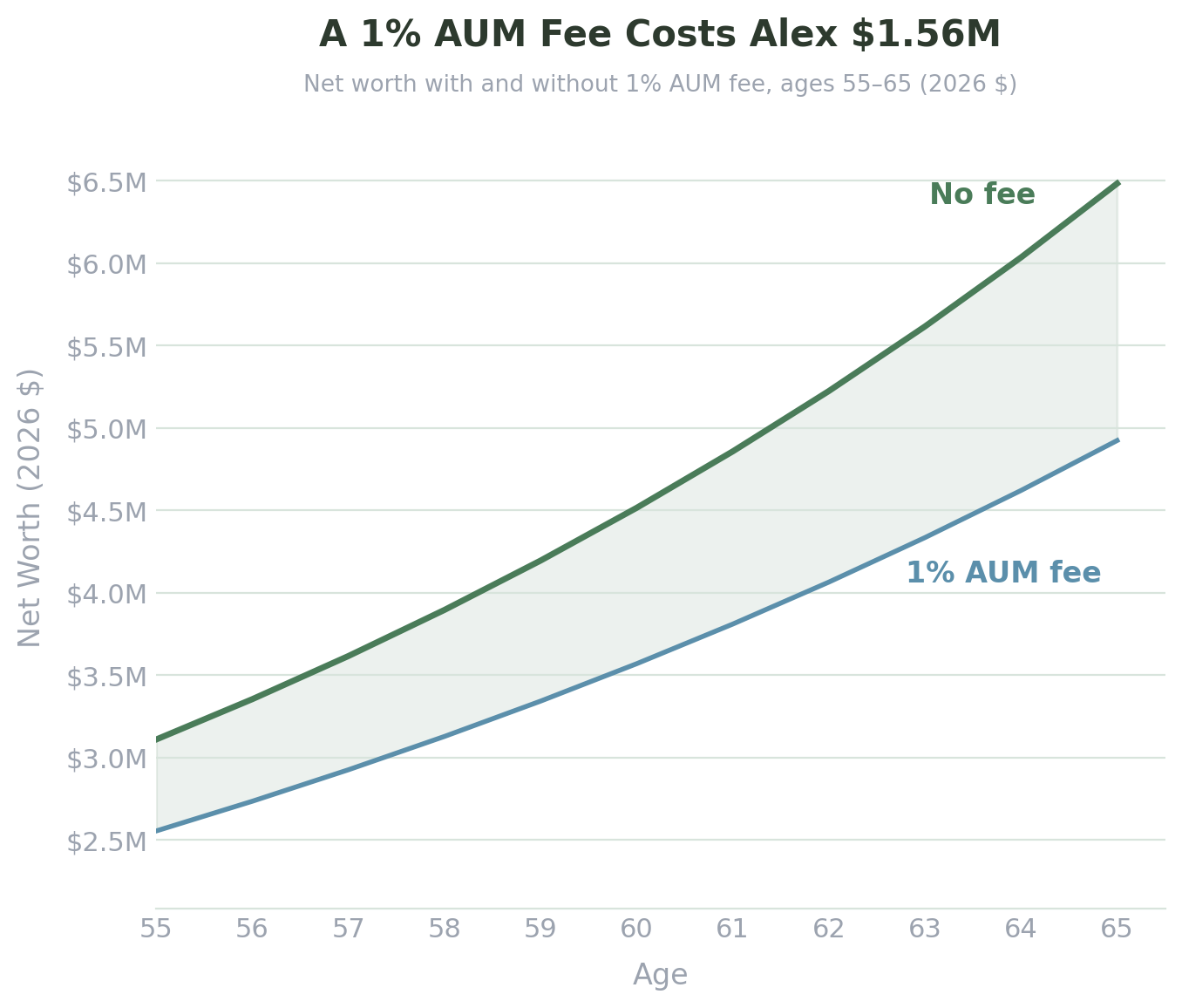
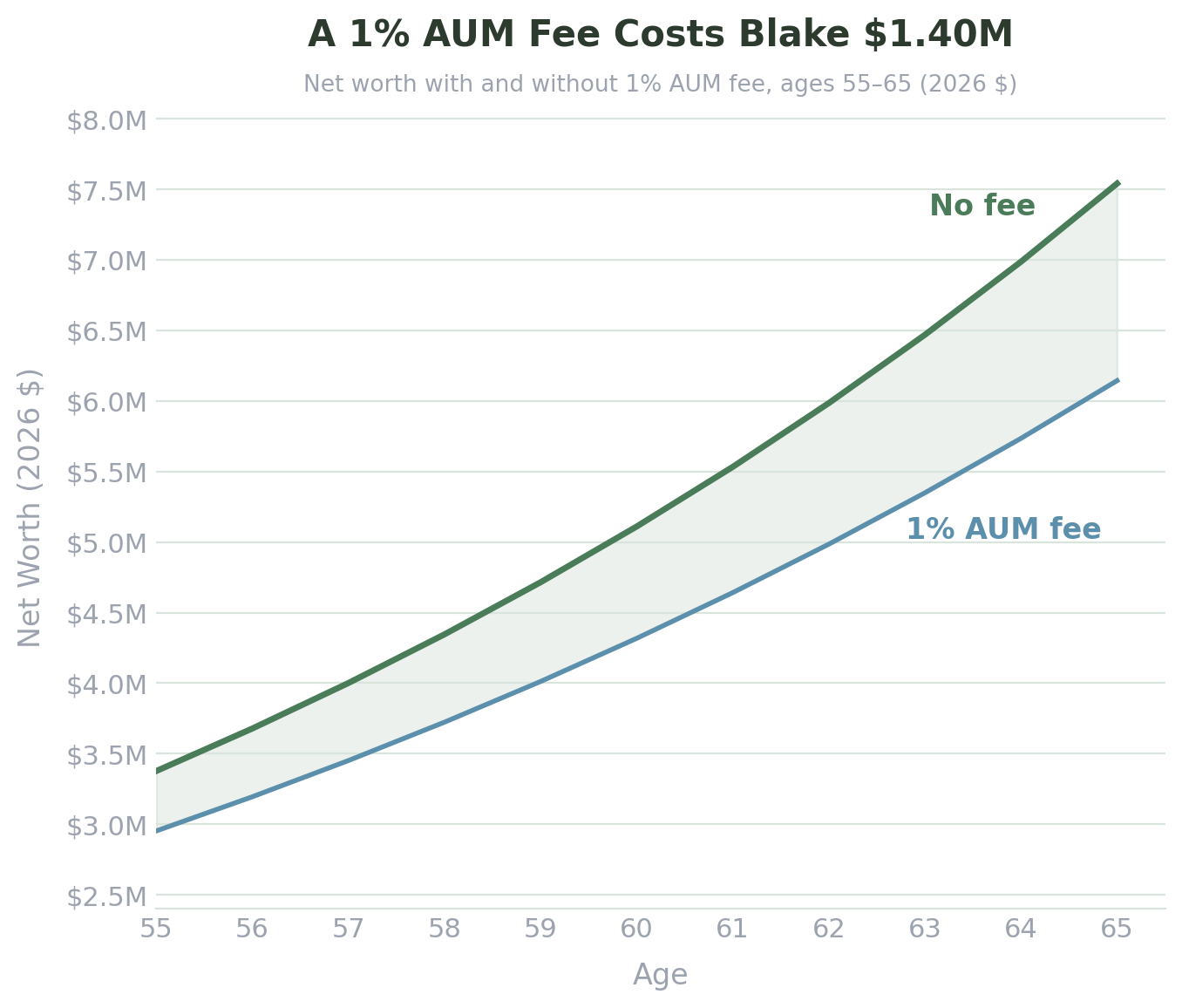
The reason the gap is so large comes down to compounding. In the previous posts on Alex and Blake, we got to see the power of long term compounding for creating wealth over the course of a career. The fees compound against you in just as powerful a fashion. A 1% fee costs more than 1% of your portfolio, because the money taken out can't keep compounding for you. A dollar taken in fees at 35 costs that dollar plus 30 years of returns on it.
This is why the losses accelerate over time. As your portfolio grows, the fees get bigger, and those losses compound against you even more. In the final decade alone, Alex loses about $1.0 million to fees and Blake loses about $970,000.
Over a full career, Alex loses $160,000 more to fees than Blake, despite earning less. Most of that gap, about $130,000, builds up before 55: Alex starts investing seven years earlier, so the fee has longer to compound. In the final decade, they lose about the same.
The Confidence You're Not Building
The fees also carry a cost that isn't in the charts.
Many physicians and high earners hand their finances over to an advisor and feel relieved to have someone else dealing with it. However, an advisor managing your portfolio doesn't teach you how to manage your own money. Most financial anxiety lives in the day-to-day questions: am I spending too much this month? Does this big purchase fit my plan? Am I saving enough? Learning to run your own numbers gives you the tools to answer these questions with confidence. No advisor can build that confidence for you.
Paying More, Getting Less
The fee calculations above assume the portfolio at least matches the market. If an advisor uses actively managed funds, that gets harder. 95% of actively managed US stock funds trailed the S&P Composite 1500, a broad US market index, over the 20 years through 2025, according to S&P's SPIVA scorecard. Over 15 years, more than 75% trailed their benchmark in every US stock fund category. If a portfolio holds funds like these, the cost is higher than the charts show.
Advisor-managed portfolios can also get complex, with many funds and overlapping positions. Complexity adds cost and makes results harder to judge. It doesn't reliably add return.
The AUM model has a structural incentive problem. An advisor's revenue grows as your portfolio grows, regardless of the value of their advice that year.
For most high earners, the answer is simpler than it looks: low-cost index funds, consistent contributions, and an understanding of your own finances.
Ready to stop wondering whether you're spending too much, saving enough, or actually on track? That's exactly what my 1:1 coaching program is built for. Feel free to reach out and set up a free consultation.
Get notified when new posts go live.